Concept demo | Product design
rerac: a daily journal for people with emotional dysregulation
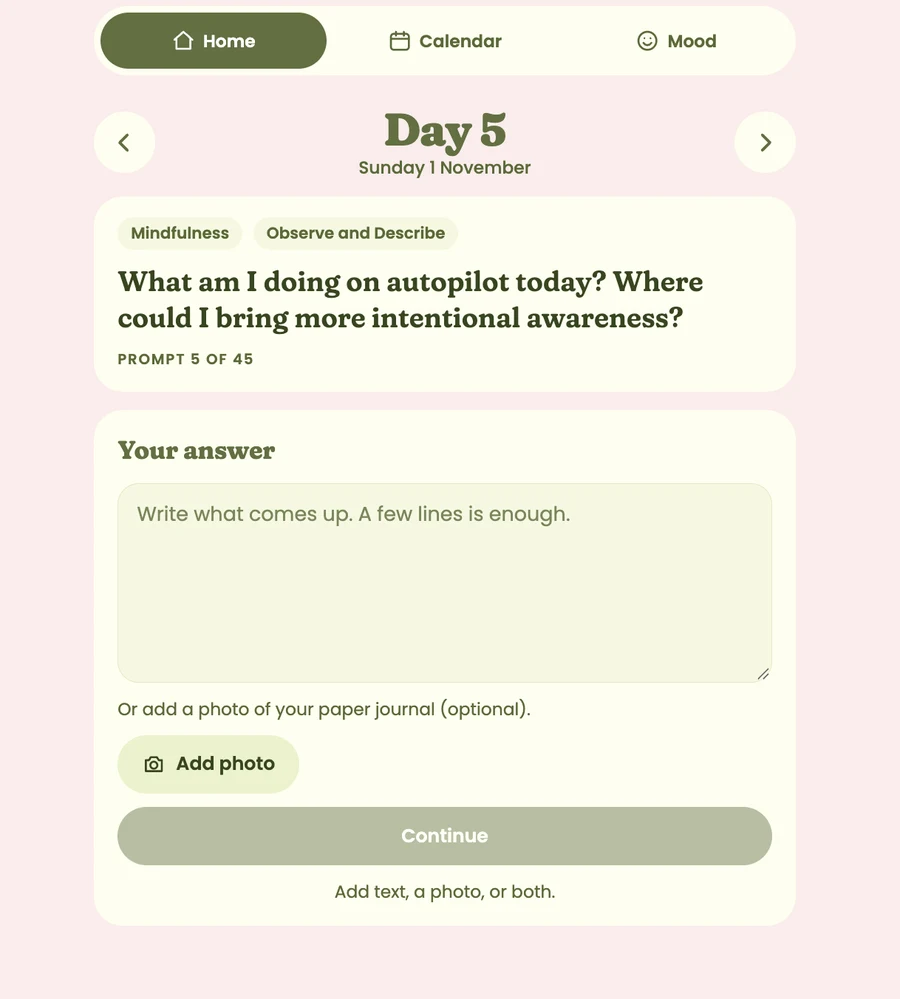
rerac is a simple daily journaling app. A person takes a 60-second check, learns how DBT journaling helps, then gets one prompt a day, answers it in text or with a photo of a paper journal, and names how they feel. A calendar and a mood view show how often they showed up and how their month felt.
Role brief, product decisions and UI design in FigmaBuilt with ClaudeStatus concept demo, October 2026
A personal project, not a medical product. It is a self-help tool, not a diagnosis and not therapy.
Try it
The daily loop, in your browser
This is a lightweight walkthrough of the daily loop. Write an answer, name the feeling, then look at the Calendar and Mood tabs. Try the arrow to read ahead.
The full demo also has the 12-question check, intro cards, all 45 prompts, a photo option and the mood trend. Nothing you type here leaves this page.
Open the full demo
The problem
A delayed collapse
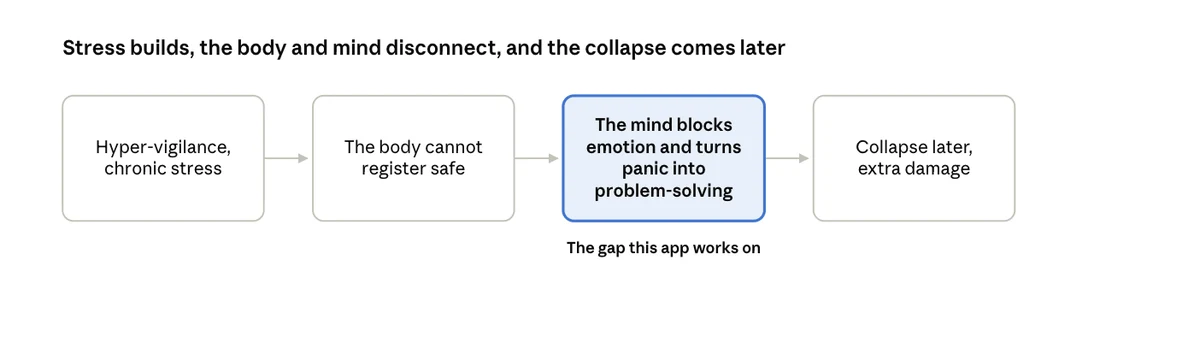
The pattern I designed for is a delayed collapse: chronic stress, a body that cannot register safety, and a mind that covers the gap with problem-solving.
- Constant vigilance puts the body into a chronic state of stress.
- The body no longer knows what "safe" or "relax" feels like.
- The mind blocks emotion because it is unbearable, and turns the panic into hyper-verbal, problem-solving or cognitively complex work.
- The collapse comes later, with extra damage from the "logical" fixes made during the distress.
Insight to design
Each choice answers one part of the pattern
| What the audience lives with | Design response | Where it shows up |
|---|
| The body does not know what "safe" or "relax" is | A short, predictable daily ritual with a calm tone and nothing to catch up on | One prompt per day, the calm day lock, a Calendar that marks only days journaled |
| A disconnect between emotions and body | Name the feeling after writing, and see where it sits in the body | Feeling picker after each entry, Map of Emotions |
| The mind turns panic into problem-solving work | Keep entries small and non-analytical | "A few lines is enough", a photo of a paper journal instead of typing, no grading of answers |
| Collapse arrives later, made worse by "logical" fixes | Make early warning easy to notice | 60-second check, month view of how feelings moved |
| Low cognitive load | Few screens and short steps | Three tabs, one prompt a day, 12 questions |
Brief and constraints
A simpler product, built on a daily prompt list
The brief: a simpler variant of an existing journaling product, with a fixed eight-step journey, built on a daily DBT prompt list. The open questions were settled up front, and most were answered with "use the default".
| Topic | Decision |
|---|
| Name | The splash shows "rerac". |
| Quiz scoring | Q1 to Q11 scored 0 to 3 (Rarely, Sometimes, Often, Almost always). Q12 is a symptom checklist, shown back but not scored. |
| Who counts as dysregulated | More than 5 of the 11 scored answers at Often or Almost always. Category bands will follow later. |
| Prompt assignment | Calendar-based: Day 1 is the first day opened, then prompts 1 to 45 in order. Demo only. |
| Storage | In the browser only. Demo only, not private per-user storage. |
| Retaking the quiz | Replaces the old result. History was considered and deferred. |
| Language and region | English only. A generic "contact local emergency services" line until a region is named. |
User journey
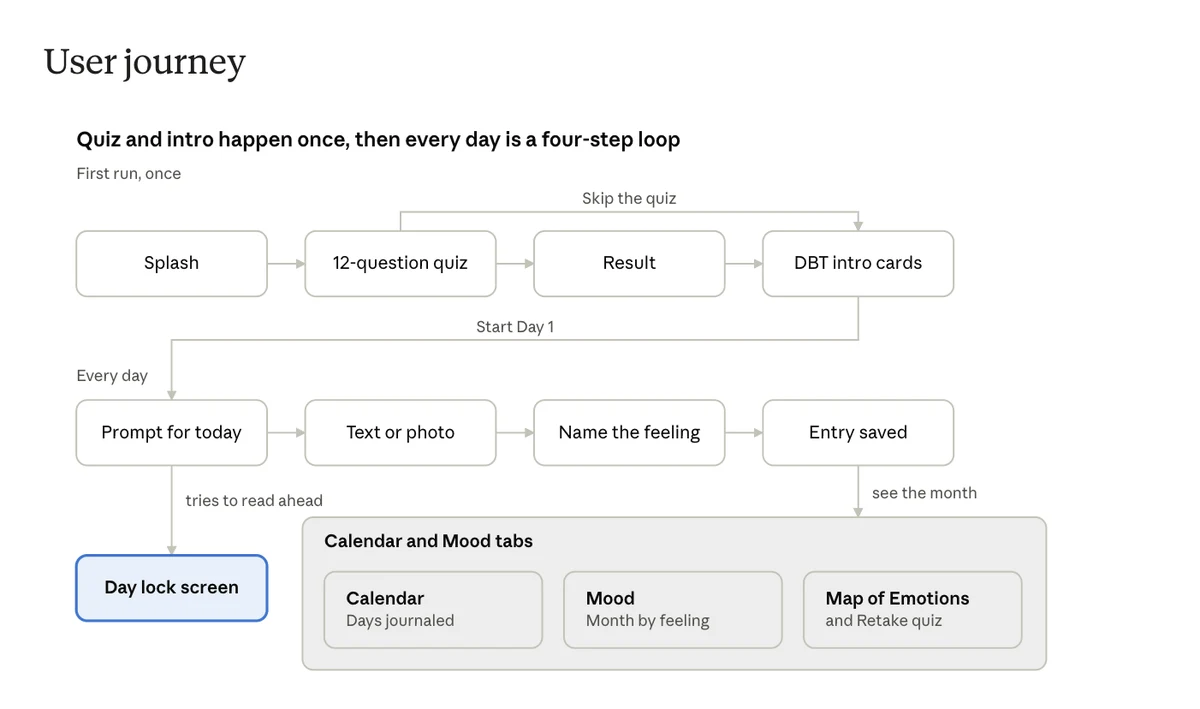
Set up once, then a four-step daily loop
On first run a person sees the splash, takes or skips the quiz, reads the result and three intro cards, then lands on Day 1. Returning users go straight to the daily loop. Reaching past today triggers the pink day lock. Retaking the quiz and the Map of Emotions live in the Mood tab.
Decisions
What I decided, and why
- A calm, warm look. Pink ground, sage green and a soft serif, in light and dark, so nothing feels clinical or urgent.
- One rule for "dysregulated". More than 5 of 11 answers at Often or Almost always. Easy to explain and test, and replaceable by real bands later.
- One prompt per day. Reading ahead triggers the pink lock screen: a calm stop that protects the habit, not an error.
- Text or photo. Typed, photographed from a paper journal, or both. At least one is needed to continue.
- Name the feeling after writing. Up to three of 16 emotions in three groups, with an optional 1 to 10 strength.
- Editable until midnight. Today can be edited. Past days are read-only.
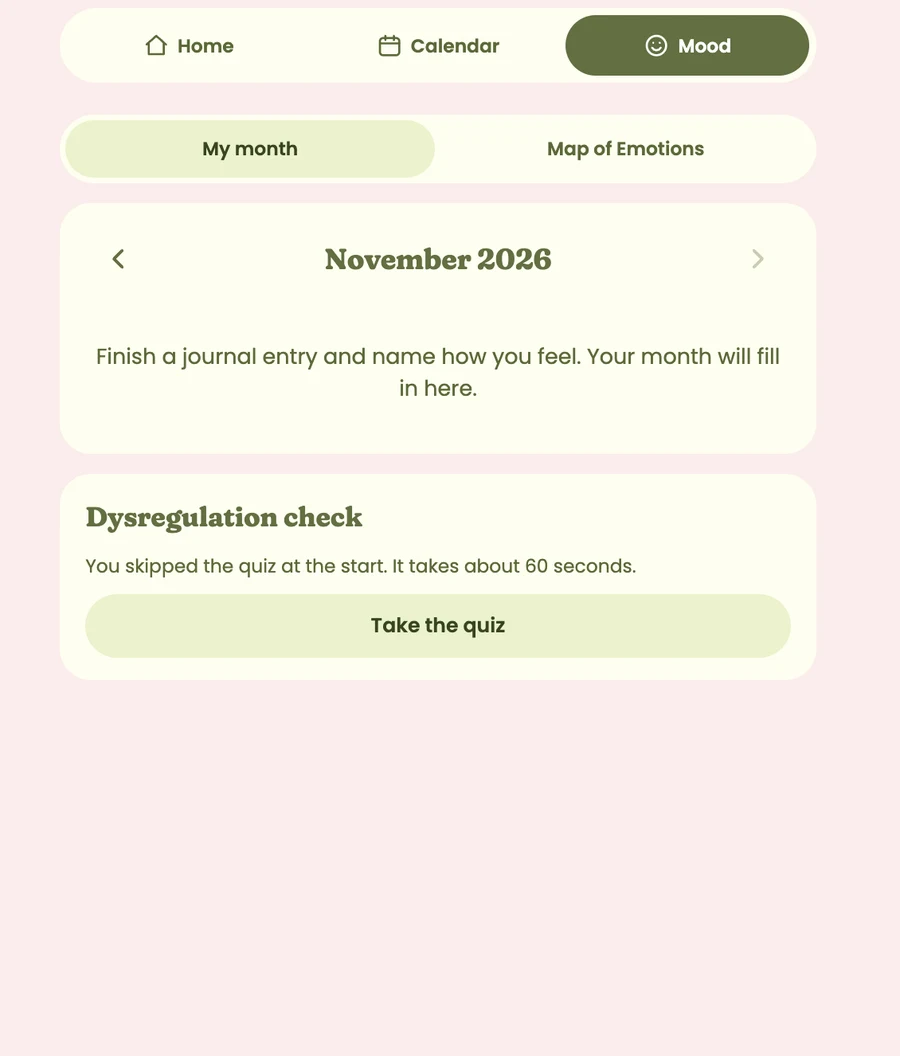
- Three tabs only. Home, Calendar and Mood. Retake quiz and Map of Emotions live inside Mood.
- Hidden demo switch. Long-press the app name for next day, a sample month and reset.
Content system
What the product holds
| Piece | What it holds |
|---|
| Dysregulation check | 12 questions in about 60 seconds. Q1 to Q11 use four answers. Q12 is a 19-item physical symptom checklist. |
| Daily prompts | 45 DBT prompts in three skill areas: Mindfulness (1 to 15), Distress Tolerance (16 to 30), Emotion Regulation (31 to 45). Each is tagged with its skill area and subgroup. |
| Emotions | 16 feelings in three groups. Pleasant: calm, content, grateful, hopeful, proud. In between: okay, tired, numb, restless. Unpleasant: anxious, sad, angry, ashamed, overwhelmed, lonely, frustrated. |
| Intro cards | Three swipe cards: "Name it to tame it", "One prompt a day", "See your month". |
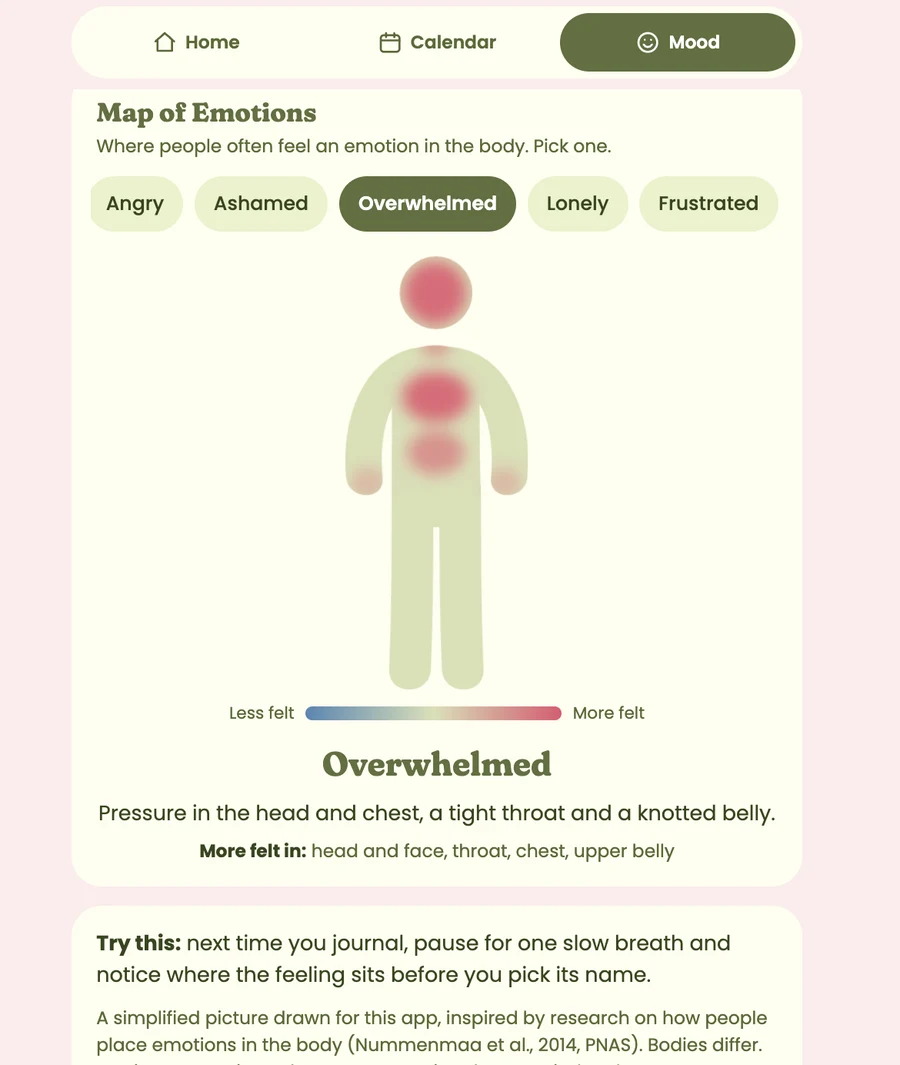
| Map of Emotions | A body figure for each of the 16 emotions, with warm and cool zones for areas felt more or less, plus a one-line description. |
After day 45 the prompts restart at 1. That is a placeholder, not a decision.
How it evolved
Four versions in three days
Each step answered one request and kept the daily loop unchanged.
| Date | Version | What changed | Why |
|---|
| Oct 30, 2026 | v4 | Map of Emotions body figure replaced and recoloured with the app palette. | A specific figure was wanted, with colours that fit the app in light and dark. |
| Oct 29, 2026 | v3 | Map of Emotions added inside Mood, switched with "My month". | Gives each logged feeling a place in the body and teaches noticing before naming. |
| Oct 28, 2026 | v2 | "Dysregulation check" card at the bottom of Mood with Retake quiz. | A retake belongs with mood tracking and keeps Home to one daily flow. |
| Oct 28, 2026 | v1 | Full journey: splash, quiz, intro, Home, Calendar, Mood, day lock and hidden demo switch. | The original brief. |
Safety, ethics and tone
What it says, and what it refuses to say
- Not a diagnosis. The result says "You seem dysregulated" or "Not dysregulated right now" and states it is a self-check. It shows how many of 11 answers were Often or Almost always, so the reasoning is visible.
- Not therapy. The intro and result screens both say it is a self-help tool and does not replace professional support.
- Crisis wording is a placeholder. The result screen points people who feel unsafe to local emergency services or a mental health professional. A country-specific line is still to be chosen.
- Map of Emotions is simplified. The body regions are hand-set approximations inspired by published research on how people place emotions in the body (Nummenmaa et al., 2014, PNAS), not the study's data. The screen says bodies differ and the map is for curiosity, not judgment.
- Gentle tone. Misses are not flagged and the Calendar marks only days journaled. It does show a day-streak count, which I would revisit for people who find streaks stressful.
Next
Open questions
- Replace the single threshold with real quiz conditions and category bands.
- Choose the country and crisis line for the result screen.
- Decide how prompts unlock (tied to the calendar, or after journaling) and what happens after day 45.
- Decide on storage beyond the demo, and whether retaking the quiz keeps a score history.
- Review whether the day-streak count suits the audience.
- Optional: show the body map right after journaling, and let people tap a body area to log where they feel it.
Prompts and quiz content were gathered from public DBT sources. The body outline is a found illustration, recoloured.
Who made this
Intan Brahmanti
I wrote the brief, designed the screens, and made the product calls on scope, scoring and tone. Claude built the working demo. If you want to see how I work on a product, from problem to decisions to delivery, this is a small, complete example.
See my CV